

 Nenah Kumar
Published July, 2026
What is Core20PLUS5?
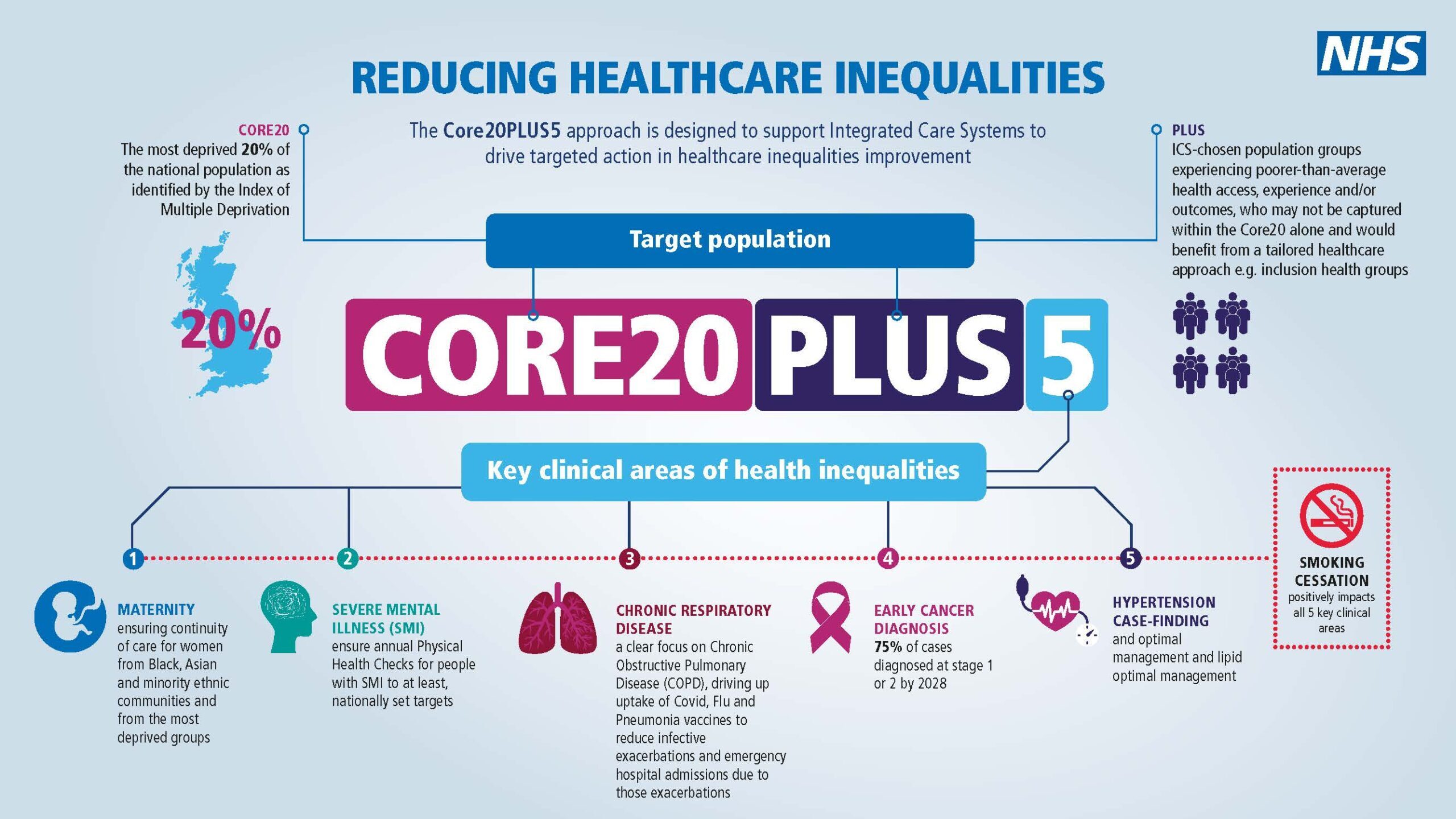
Core20PLUS5 is NHS England's national framework for tackling healthcare inequalities, built around three elements: a target population (Core20), a set of inequality groups (PLUS), and five clinical areas where focused action is expected to have the biggest impact.
It was developed to give NHS organisations, from Integrated Care Systems (ICSs) down to individual trusts and primary care networks, a shared, practical structure for inequalities work, rather than leaving it as an abstract commitment.
-1.png?width=1999&height=1077&name=Untitled%20design%20(34)-1.png)
What Does "Core20" mean?
Core20 refers to the most deprived 20% of the national population, as identified by the Index of Multiple Deprivation (IMD). This is the baseline group the framework asks NHS organisations to prioritise when planning and delivering services.
What does "PLUS" mean?
PLUS refers to additional inequality groups that NHS organisations should also consider, beyond geographic deprivation alone. NHS England intends PLUS groups to be determined locally, based on the population an ICS or trust actually serves, but nationally identified examples typically include groups such as:
- Ethnic minority communities
- People with a learning disability and/or autistic people
- Inclusion health groups (for example, people experiencing homelessness, Gypsy, Roma and Traveller communities, vulnerable migrants, and sex workers)
- People with multiple long-term health conditions
- Protected characteristic groups under the Equality Act 2010
- Coastal and rural communities with pockets of deprivation not captured by IMD alone
What are the 5 clinical areas?
This is where it gets more specific, and where the framework splits into two versions.
Adult Core20PLUS5 focuses on five clinical areas commonly cited as:
- Maternity
- Severe mental illness
- Chronic respiratory disease
- Early cancer diagnosis
- Hypertension case-finding
Children and Young People's (CYP) Core20PLUS5 have its own five areas, commonly cited as:
- Asthma
- Diabetes
- Epilepsy
- Oral health
- Mental health
What does language access matter to Core20PLUS5?
Several PLUS groups map directly onto people who may need an interpreter, translated materials, or accessible communication support to engage with NHS services at all: ethnic minority communities, vulnerable migrants, Gypsy, Roma and Traveller communities, and people with a learning disability among them.
If a patient cannot understand their maternity appointment, their personalised care plan, or their cancer screening invitation, the clinical intervention behind that Core20PLUS5 priority cannot land. Communication access is not adjacent to Core20PLUS5 delivery, it is a precondition for it.
This is also why Core20PLUS5 reporting increasingly asks organisations to evidence how they're reaching underserved groups, not just what services exist on paper. Interpreting and translation data, such as language coverage, booking response times, and BSL provision, can form a concrete part of that evidence base.
-1.png?width=2000&height=1228&name=Untitled%20design%20(33)-1.png)
Delivering Core20PLUS5 in your organisation?
We support NHS trusts, ICSs, and PCNs with the interpreting, translation, and accessibility services that sit behind inequalities reporting, from on-demand telephone interpreting to BSL and translated patient materials.
If you need support reaching wider communities, contact our specialist team: getintouch@word360.co.uk
How we support this
We work with NHS and public sector organisations to remove the language and communication barriers that sit directly inside several PLUS groups.
Our interpreting services cover face-to-face, telephone, video and AI interpreting across a wide range of languages, supporting patient-facing teams working with ethnic minority communities and vulnerable migrants.
Our translation and accessibility services cover translated patient materials, easy read documents, and BSL interpreting, supporting patients with a learning disability and Deaf patients across the five clinical areas, from maternity information to cancer screening invitations.
A final note
Core20PLUS5 gives NHS organisations a clear structure, but delivering against it depends on whether patients in the priority groups can actually understand and act on the care they're offered. For a meaningful share of the Core20 and PLUS populations, that starts with language and communication access.
Treating interpreting, translation, and BSL provision as a core part of Core20PLUS5 delivery, rather than a separate compliance task, makes the framework's five clinical areas much more achievable in practice, rather than just on paper.
Reach out to our team for more information on how you can ensure your organisation is 100% reaching Core20PLUS5 communities: getintouch@word360.co.uk

Recent articles
.png?width=300&name=AI%20in%20Healthcare%20-%20Blog%20Images%20%20(4).png)
.png?width=300&name=Website%20Featured%20Image%20%20(2).png)

.png?width=600&height=300&name=Untitled%20design%20(2).png)
.png?width=600&height=300&name=Untitled%20design%20(4).png)